2024
This document provides a precise reference specification for the
Python class QBitwave, used in the associated manuscripts.
It formalizes the mapping from discrete bitstrings to emergent complex
amplitudes and describes derived quantities such as Shannon entropy,
compressibility, and coherence.
Let:
\(b = (b_1,\dots,b_N) \in \{0,1\}^N\) denote a bitstring of length \(N\).
\(B = \{0,1\}^N\) denote the set of all bitstrings of length \(N\).
\(n_\text{block}\) denote the block size for bit-to-amplitude conversion (even integer).
\(\mathbb{C}\) denote the complex numbers.
\(\|\cdot\|_2\) denote the Euclidean norm.
Given normalized complex amplitudes \(\psi = (\psi_1, \dots, \psi_M) \in \mathbb{C}^M\) and associated phases \(\phi = (\phi_1,\dots,\phi_M)\): \[\begin{aligned} \psi_j &= r_j e^{i \phi_j}, \quad r_j = |\psi_j|, \quad j = 1,\dots,M, \\ b_\text{amp}^j &= \text{binary\_encode}(r_j, k_\text{amp}), \\ b_\text{phase}^j &= \text{binary\_encode}\left(\frac{\phi_j}{2\pi}, k_\text{phase}\right), \end{aligned}\] where \(k_\text{amp}, k_\text{phase}\) are user-selected bits per amplitude/phase. The flattened bitstring is \[b = \bigoplus_{j=1}^M \bigl( b_\text{amp}^j \, || \, b_\text{phase}^j \bigr),\] with \(||\) denoting concatenation.
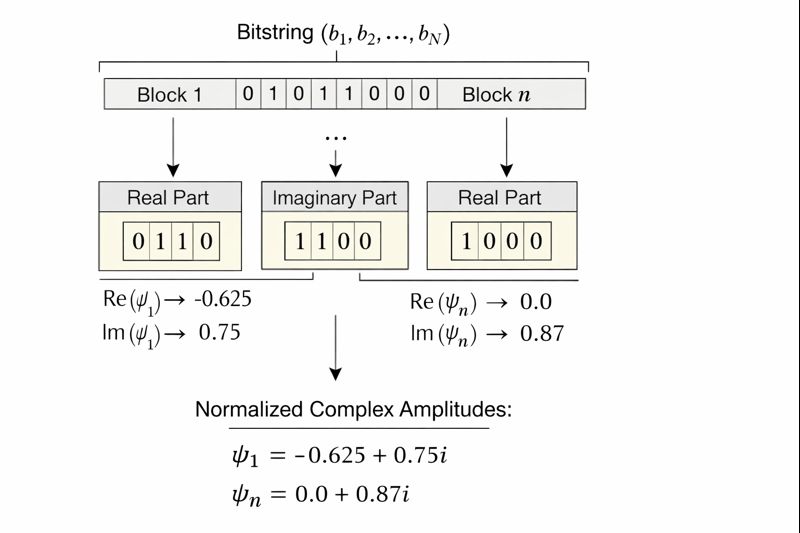
Partition the input bitstring \(b\) into consecutive blocks of size \(n_\text{block}\): \[\begin{aligned} b &= (b_1, \dots, b_N), \quad n_\text{block} \mid N, \\ n_\text{blocks} &= N / n_\text{block}. \end{aligned}\]
Each block is split into two halves (real and imaginary parts): \[\begin{aligned} \text{Re}(\psi_j) &= \text{bits\_to\_signed\_float}\left(b_{(j-1)n_\text{block}+1:j n_\text{block}/2}\right), \\ \text{Im}(\psi_j) &= \text{bits\_to\_signed\_float}\left(b_{j n_\text{block}/2+1:j n_\text{block}}\right), \end{aligned}\] and then normalized: \[\psi = \frac{\psi}{\|\psi\|_2}.\]
\[p_j = |\psi_j|^2, \quad \sum_{j=1}^M p_j = 1.\]
\[S_\psi = - \sum_{j=1}^M p_j \log_2 p_j.\]
Let \(p_0, p_1\) be the fractions of zeros and ones in \(b\): \[H_b = -p_0 \log_2 p_0 - p_1 \log_2 p_1.\]
The Kullback–Leibler divergence between bit-level and amplitude-level distributions: \[D_\text{KL}(P_b \parallel P_\psi) = \sum_{i=0,1} P_b(i) \log_2 \frac{P_b(i)}{P_\psi(i)},\] where \(P_\psi\) is truncated/aligned to the same length as \(P_b\).
Define the Fourier transform of amplitudes: \[\hat{\psi} = \text{FFT}(\psi),\] and let \(N_\text{sig}\) be the number of Fourier coefficients with magnitude above threshold \(\tau\). Then \[C = 1 - \frac{N_\text{sig}}{M}, \quad C \in [0,1].\]
Small perturbations of the amplitudes \(\psi \to \psi + \eta\), with \(\eta \sim \mathcal{CN}(0, \sigma^2)\) (complex Gaussian), are normalized to unit norm. Random bit flips on \(b\) trigger automatic recomputation of \(\psi\).
from qbitwave import QBitwave

bw = QBitwave(bitstring)
amps = bw.get_amplitudes()
entropy = bw.entropy()
bit_entropy = bw.bit_entropy()
coherence = bw.coherence()
compress = bw.compressibility()
bw.mutate(level=0.01)
bw.flip(n_flips=5)The following properties are essential to the analytical results:
Normalization of amplitudes
Mapping from bitstring to complex amplitudes
Computation of Shannon entropy and compressibility
All other methods (e.g., random flips, mutation) are ancillary and used only in simulation studies.