
The system is defined by a binary configuration string St of fixed total length L. The initial state S0 corresponds to the all-zero bitstring, establishing an initial boundary condition where Shannon entropy is minimised:
Consistent with Paper I’s rejection of any externally imposed clock or agent [meskanen2001], the evolution is not driven by an external ”bit-flipper.” At each raw tick, one of the L positions is selected uniformly at random — a choice determined entirely by internal, countable facts about the current configuration (how many positions currently hold each value), not by any external rule — and that position’s value is toggled. Tracking k(traw), the number of 1-bits in St after traw raw ticks, this process is exactly the Ehrenfest urn model [ehrenfest1907]:

Writing p(traw) = k(traw)∕L and the rescaled time τ = traw∕L, the mean trajectory obeys dp∕dτ = 1 − 2p, with exact solution
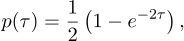
a closed-form, L-independent relaxation curve from p = 0 toward the equilibrium value p = 1∕2. Note that τ is a rescaled variable, not a raw tick count: τ = O(1) corresponds to O(L) actual bit-flip events having occurred. This distinction matters throughout, and especially in Section 5.3.
Two distinct timescales govern this process and should not be conflated: the relaxation time L∕2 (in raw ticks), governing how fast the mean of k approaches equilibrium, and the sharp mixing (cutoff) time (L∕4)lnL, governing when the distribution of k becomes statistically indistinguishable from its equilibrium shape [diaconis1990hypercube]. We use the exact process above, not the mean-field curve alone, wherever the distinction matters.
We define a minimal local target pattern string P of length w0, with a ones and b = w0 − a zeros. The global string St is parsed into non-overlapping blocks of size w0, yielding a raw background capacity of Nmax = L∕w0 elements. A Level-0 “space fabric” token exists at index m if the block matches the binary target integer value V P :
![{ ∑w0 −1 w0−1−j
σG [m ] = 1 if j=0 St[m ⋅w0 + j]⋅2 = VP
0 otherwise](emergence-of-spacetime3x.svg)
The raw count of detected space fabric elements is NG = ∑ σG[m].
Higher-order structural tiers (representing Hadrons, Atoms, and Compounds sequentially) are extracted by recursively filtering the underlying layer’s output array. For a given structural level k ∈{1,2,3}, the input array is scanned using a non-overlapping window of width wk subject to a density activation threshold τk:
![{ ∑
1 if wjk=−01 σk−1[m ⋅wk + j] ≥ τk
σk[m] = 0 otherwise](emergence-of-spacetime4x.svg)
The raw abundance of entities at level k is given by Nk = ∑ σk[m]. As discussed in Section 3, the qualitative shape of Nk as a function of entropy is fixed by the effective composition (a,b) implied by each level’s threshold τk, and should be checked explicitly rather than assumed.