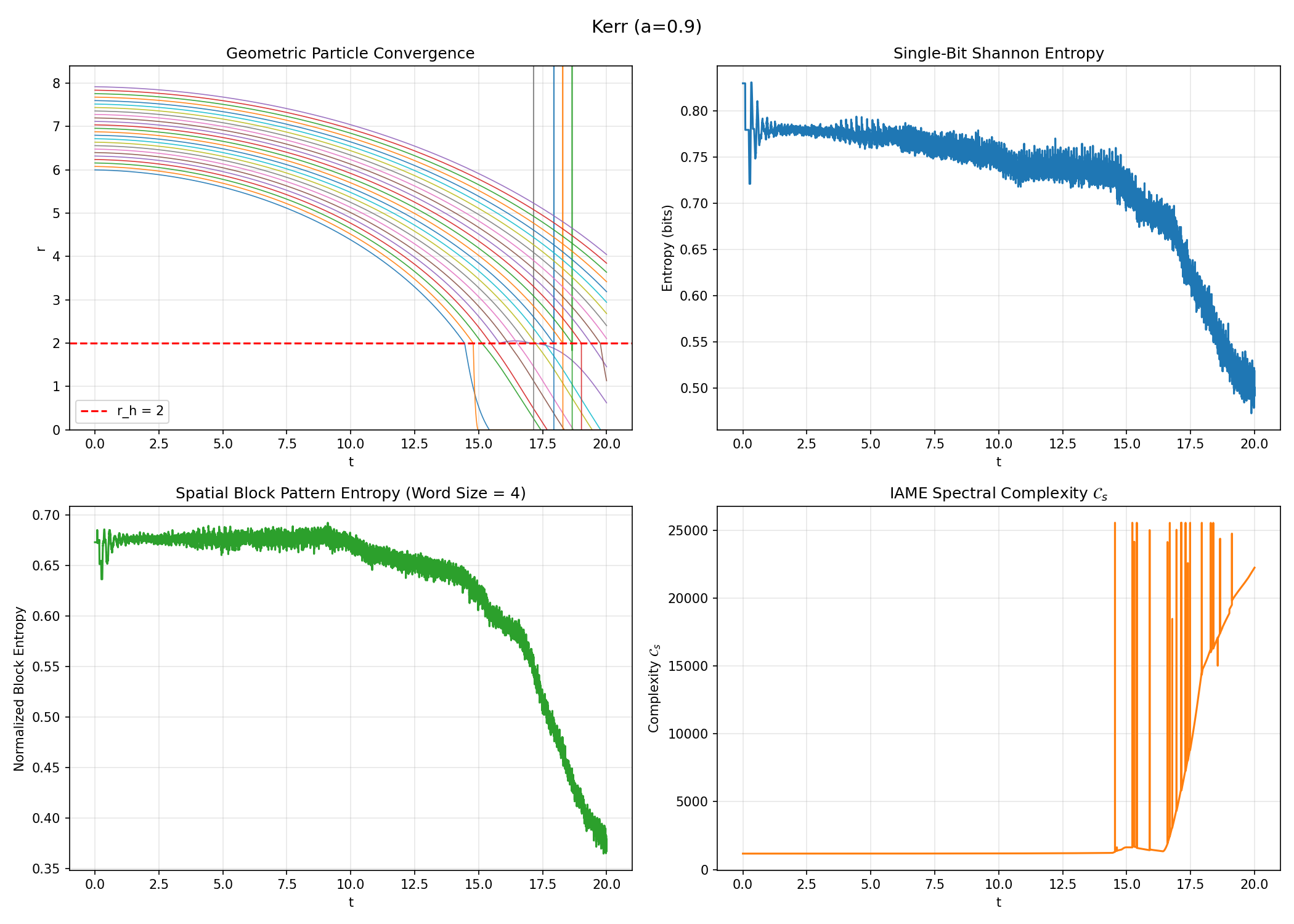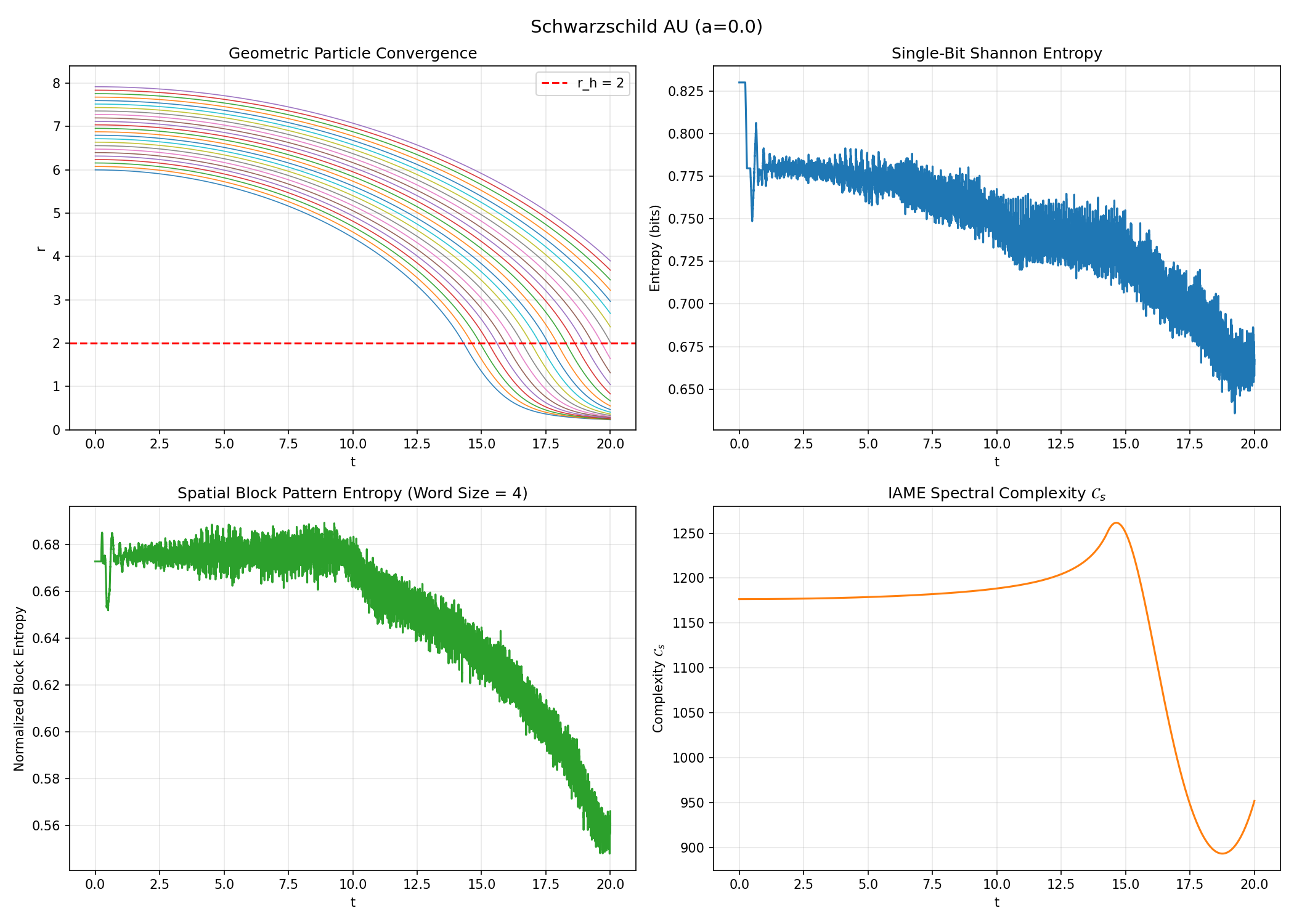
We simulated gravitational collapse for Schwarzschild (implemented in both Advanced Unistructural and Eddington-Finkelstein coordinate presentations) and Kerr (a = 0.9) geometries using discretised dust cloud models. In each case, a spherically symmetric distribution of N = 100 particles is initialised outside the horizon and evolved using a fourth-order Runge-Kutta (RK4) integrator with a time step dt = 10−3 until numerical breakdown or coordinate horizon termination. The geometric states are processed through the complete informational suite at each timestep.
The informational metrics yield contrasting signatures across different spacetime geometries, uncovering physical characteristics of the collapse that are invisible to standard curvature calculations.
In all configurations, the single-bit Shannon entropy H(bt) and pattern block entropy Hn(bt) decrease as particles fall inward toward the singularity. Their curves track each other identically, demonstrating that macroscopic structure and microscale binary data variety decay in tandem as the configuration space collapses.