
Let ℳ denote the set of all memory locations in a deterministic computing system. A machine state 𝒮∈ℳ is a complete assignment of values to all memory elements. Let 𝒫 = (I1,I2,…,In) be a finite sequence of deterministic instructions, with Ik : 𝒮→𝒮. The execution trace 𝒯 of program 𝒫 is the ordered sequence of states
The execution trace encodes all information about the simulated phenomenon. By the representational equivalence of Section 2, it encodes all information about the physical phenomenon as well. In practice, we focus on the bitstring sub-trace: the subsequence of memory states that encodes the spatial geometry of the simulated system.
Let a geometric state at time t be encoded as a bitstring bt ∈{0,1}L, representing the discretised positions of all particles in the simulated dust cloud. Let
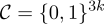
be the space of three-dimensional configurations. Define the decoding map

where ϕ : {0,1}k →ℤ decodes fixed-length binary segments into integers via standard binary representation. Distinct bitstrings decode to distinct integer triples. Quantisation of continuous coordinates to fixed-width integers eliminates spurious entropy contributions from floating-point representation and ensures that the entropy of the bitstring faithfully reflects the geometric distinguishability of the encoded states.
To extract both macroscale pattern formation and microscale structural disorder during gravitational collapse, we evaluate the particle coordinate distribution using two complementary informational metrics.
At each simulation timestep t, the full geometric state is mapped onto a vector of continuous positions, which are evaluated as a 1D spatial array of radii rn or coordinate positions. To evaluate low-level bitwise diversity, this spatial state is scaled by an integer mapping constant α = 1000.0 and parsed at the raw bit level. We compute the Shannon entropy of the empirical bit-frequency distribution:

where p0(t) and p1(t) are the global frequencies of zero- and one-bits across all parsed words at time t. This measures the fundamental distinguishable variety encoded in the machine representation.
Because single-bit Shannon entropy treats bits as independent identically distributed variables, it can obscure localized correlations. We implement a spatial pattern variety metric by grouping the bitstream into consecutive sequences of fixed word size n = 4. The normalized block entropy is defined as:

where P(ωi) is the empirical probability of occurrence of the i-th binary pattern word ωi ∈{0,1}n. Due to the fixed scaling properties inherent in binary integer transitions, Hn(bt) tracks tightly with H(bt), confirming a high degree of correlation between individual bit state changes and pattern distributions during spatial collapse.
Lemma. Let ℬt ⊂{0,1}L denote the bitstring encoding the geometric state at time t. If H(ℬt) → 0, then the set of distinguishable geometric configurations collapses to a single equivalence class under f.
Proof. H(ℬt) = 0 if and only if all bits of ℬt take the same value, i.e. ℬt ∈{0L,1L}. Each such bitstring decodes to a single geometric object - a point. The set of distinguishable configurations therefore contains exactly one element. □
Corollary. A zero-entropy bitstring, under any geometric decoding, resolves to a single structureless point. This result is independent of the choice of decoding map f. The zero-entropy state has no internal structure available to encode microstructures, such as particles.