General relativity does not concern itself with observations. The universe exists with or without intelligent, conscious observers or their interpretations of collapsing wavefunctions. As far as general relativity is concerned, observers are no different from rocks. A psychosocially complex, traumatized, and poorly maintained human falling into a black hole is treated no differently from a rock of the exact same mass.
The universe is geometric by nature.
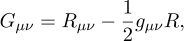
The dynamics of the geometry are governed by the famous Einstein field equations:
| (14.1) |
where Gμν is the Einstein tensor:
| (14.2) |
and Tμν is the stress–energy tensor, which encodes energy density, momentum density, pressure, and shear stress.
These equations equate geometry with matter. As the physicist John Wheeler famously summarized: Spacetime tells matter how to move. Matter tells spacetime how to curve.
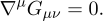
A profound mathematical feature of these equations is the contracted Bianchi identity. It states that the covariant divergence of the Einstein tensor vanishes identically:
| (14.3) |
Because the field equations equate Gμν with the stress–energy tensor Tμν, this identity mathematically forces the local conservation of energy and momentum:
| (14.4) |
Conservation of energy isn’t an extra rule programmed into the universe; it is a logical consequence of the geometry itself.
While Quantum Field Theory (QFT) deals with the “values” inside the cells of the universe, General Relativity (GR) defines the “distance” between those cells and the rules for traversing them. Mathematically, we model this universe as a four-dimensional differentiable manifold ℳ equipped with a metric tensor gμν.
The metric determines distances, time intervals, angles, and the causal structure of reality. The infinitesimal spacetime interval is given by:
| (14.5) |
This single, elegant geometric object entirely replaces the Newtonian gravitational potential, absolute space, and absolute time. Crucially, the metric is not a passive background grid; it is dynamic. Spacetime geometry actively responds to the distribution of matter and energy.
The so-called Equivalence Principle states that inertial mass and gravitational mass are identical. In Newtonian mechanics, a falling object accelerates because a physical force pulls on it. In General Relativity, no force acts at all.
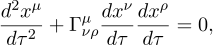
Instead, the particle is simply trying to move in a straight line, or “follow its nose” through a curved environment. It follows a geodesic:
| (14.6) |
where Γνρμ represents the Christoffel symbols constructed from the metric.
This equation is the ultimate lazy-evaluation algorithm: it describes pure, unforced inertial motion. Gravity disappears locally. What we perceive as gravitational attraction is just nearby geodesics naturally converging in curved space.
Just like a transformation matrix can be decomposed into four basic transformations, such as rotation and scale matrices, also Riemann curvature tensor can be decomposed to various other tensors.
The curvature of spacetime is encoded in the Riemann curvature tensor:
| (14.7) |
It measures the failure of parallel transported vectors to return unchanged after transport around infinitesimal loops. Contractions of the Riemann tensor yield the Ricci tensor Rμν and the Ricci scalar R, which summarize the curvature relevant to volume distortion and geodesic convergence.
While the Ricci tensor describes how matter locally curves spacetime, it does not tell the whole story. The Riemann tensor can be decomposed into the Ricci curvature, which vanishes in a vacuum, and the Weyl curvature, which does not. The Weyl tensor is responsible for tidal forces and allows gravitational influence to propagate through the vacuum of space as gravitational waves (not again, nature waves!)
The most intuitive way to understand the Ricci scalar (also known as the scalar curvature, denoted as R without tensor subscripts) is to think of it as a measure how much the volume of a region in curved space deviates from a flat, Euclidean space.
Because the metric gμν varies depending on where you are and how much mass is around, time itself is geometry-dependent. For a stationary observer:
| (14.8) |
Clocks at different gravitational potentials tick at different rates. This means time is not a global, absolute clock. It is, in fact, a deeply personal issue.
To demonstrate this, let us imagine an average programmer in a safe orbit around a black hole. As a thought experiment, we will consider the scenario of the programmer pushing his wife into the black hole. While this is undoubtedly a terrible thing to do, it serves as an excellent scientific test—provided we keep in mind that it is purely hypothetical, and not a recommendation.
The closer the falling wife gets to the event horizon, the slower she appears to fall from her husband’s perspective. To him, she will never actually seem to cross it. A distant husband would have to wait an infinite amount of time to watch his wife pass the point of no return.
Things look very different from the wife’s point of view (as usual!). For her, there is no dramatic physical boundary at the event horizon. Her watch keeps ticking normally. As she falls, she can look back and see the light from the outside universe perfectly well. Because of gravitational blueshift and time dilation, the outside universe appears sped up and energetic. Yet, because she is falling so quickly, she has only a limited proper time—seconds or minutes—before hitting the singularity. She crosses the horizon smoothly, seeing only a finite slice of the universe’s future, and meets her doom inside.
Black holes eventually evaporate via Hawking radiation. Since the husband sees his wife take almost “infinite time” to cross the horizon, and the black hole will eventually evaporate in a finite (albeit unimaginably long) time, there is a small chance that the black hole disappears just before she even hits the singularity. The horizon can shrink faster than she can cross it, or the singularity vanishes before her proper time can run out.
Not all information that passes through the event horizon is necessarily lost. You can’t even trust black holes!
Of course, surviving such a trip is strictly the domain of science fiction anyway.
Fierce tidal forces would “spaghettify” and tear any observer apart. To resolve the clash of two different perspectives, some physicists argue that the horizon isn’t a peaceful gateway at all, but a raging “firewall” of quantum energy that would vaporize the wife the moment she touched it. So the programmer’s wife would also get burned quite badly - receive a highly boosted cosmic sunburn as a parting gift.
On the bright side, she would find her husband aging rapidly relative to her—if that is any consolation!
Unlike quantum mechanics, which is a theory of states evolving tick-by-tick in time, General Relativity is a theory of consistent four-dimensional configurations.
Given suitable boundary conditions, the Einstein equations constrain the allowed geometries of the entire cosmos. Time evolution is not fundamental; it is simply a human slicing of a four-dimensional structure. The equations are elliptic-hyperbolic constraints on geometry. This is why the initial value problem is so subtle, global solutions are rare, and exact solutions are highly symmetric. Spacetime is not computed step-by-step; it exists as a self-consistent, static whole.
This suggests that we live in a static Block Universe. The falling observer and the frozen observer are both real; they are simply viewing the same static, 4D geometric structure from different perspectives. The past, the present, and the future all exist simultaneously as the geometry of four-dimensional spacetime. Change is an illusion of the observer; reality is simply the geometry of the whole.
General Relativity says that gravity isn’t a force, but the shape of the container. However, it describes the behavior of the container without explaining the fabric of the container itself.
Then the theory predicts points of infinite density. The singularity at the center of a black hole is not a mere coordinate glitch, but a point of ultimate physical breakdown: a place where all of the matter from a collapsed star (say, ten times the mass of our Sun) is crushed down into a region of literally zero radius (r = 0). This forces the density and the curvature of spacetime to become infinite (ρ →∞, R →∞).
Furthermore, GR treats spacetime as a perfectly smooth manifold. It works flawlessly until one zooms in to the so-called Planck scale—the threshold where the smooth geometry of General Relativity collides with the discrete, pixelated fluctuations of Quantum Mechanics.
This fundamental clash is the main reason why many argue Einstein’s theory of gravity, brilliant as it is, cannot be the final word.