 for a single metric hop at 𝜖 = π∕4. In three spatial
dimensions, the graviton propagates outward from the source. By conservation of graviton flux over
spherical shells, the field amplitude at distance r satisfies
for a single metric hop at 𝜖 = π∕4. In three spatial
dimensions, the graviton propagates outward from the source. By conservation of graviton flux over
spherical shells, the field amplitude at distance r satisfies
The graviton amplitude theorem gives ∥W∥max = 1∕ for a single metric hop at 𝜖 = π∕4. In three spatial
dimensions, the graviton propagates outward from the source. By conservation of graviton flux over
spherical shells, the field amplitude at distance r satisfies

giving

Theorem 4 (Newtonian potential from graviton flux). Let source mass M produce graviton field
amplitude AM(r) = ∥WM∥∕(2 r) and test mass m produce A
m(r) = ∥Wm∥∕(2
r) and test mass m produce A
m(r) = ∥Wm∥∕(2 r), both
evaluated at distance r from their respective centres. With ∥W∥∝M (more bits produce stronger
field; see Open Problem 1 in Section 8), the interaction potential from the field overlap integral
r), both
evaluated at distance r from their respective centres. With ∥W∥∝M (more bits produce stronger
field; see Open Problem 1 in Section 8), the interaction potential from the field overlap integral

evaluated with lower cutoff rmin = ℓP (Planck length), gives

The factor 8π = 2 × 4π arises entirely from spherical geometry.
Proof sketch. Substituting AM(r) = ∥WM∥∕(2 r) and A
m(r) = ∥Wm∥∕(2
r) and A
m(r) = ∥Wm∥∕(2 r) into the overlap
integral (both amplitudes evaluated at the same radial distance r from the interaction midpoint,
which introduces the factor 1∕R from the separation):
r) into the overlap
integral (both amplitudes evaluated at the same radial distance r from the interaction midpoint,
which introduces the factor 1∕R from the separation):

With ∥WM∥ = M∕ and ∥Wm∥ = m∕
 :
:
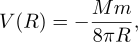
giving G = 1∕(8π) in Planck units.
Note: this is a proof sketch, not a full derivation. The proportionality ∥W∥ ∝ M is assumed; see Open Problem 1. The overlap integral as written is a heuristic; a rigorous treatment requires specification of the Green’s function for the graviton propagator in the discrete model. □
The factor 4π appearing in the spherical shell area is the same factor that appeared in Paper IV when recovering the Bekenstein–Hawking entropy: flat raster geometry must be corrected to spherical geometry by multiplying by 4π. Its appearance here confirms geometric consistency: 4π is not a free parameter but the unique conversion between discrete counting and spherical propagation, appearing wherever the model transitions from flat to spherical three-dimensional geometry.
The amplitude product A(r) ⋅r = ∥W∥max∕(2 ) is constant to machine precision across all r, confirming
exact 1∕r falloff. The force F(r) = −dV∕dR ∝ 1∕R2 follows analytically from V ∝ 1∕R. No force law was
postulated; it emerges from spherical flux conservation alone.
) is constant to machine precision across all r, confirming
exact 1∕r falloff. The force F(r) = −dV∕dR ∝ 1∕R2 follows analytically from V ∝ 1∕R. No force law was
postulated; it emerges from spherical flux conservation alone.