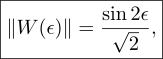
The lifecycle of the graviton follows immediately: ∥W∥ = 0 at 𝜖 = 0 (static metric, no wave), ∥W∥ = 1∕ at 𝜖 = π∕4 (peak amplitude), ∥W∥ = 0 at 𝜖 = π∕2 (static again). This mirrors the virtual boson lifecycle
of Paper VII exactly.
at 𝜖 = π∕4 (peak amplitude), ∥W∥ = 0 at 𝜖 = π∕2 (static again). This mirrors the virtual boson lifecycle
of Paper VII exactly.
Proof. ∥ρ∥2 = Tr(ρ2) = Tr(ρ) = 1 for any pure state. The three components ρRicci, ρtidal, ρgraviton
occupy mutually orthogonal subspaces of the matrix algebra (diagonal; symmetric off-diagonal;
antisymmetric off-diagonal), so ∥ρ∥2 = ∥ρRicci∥2 + ∥ρtidal∥2 + ∥ρgraviton∥2 = 1. □ □
Remark (Bridge to Paper VIII). Corollary 3 is the metric-configuration analogue of the
fermion-boson conservation law ∥F∥2+∥B∥2 = 1 of Paper VIII. Both are consequences of the single
identity ∥ρ∥2 = 1 for pure states, applied to different physical degrees of freedom. The conservation
law is universal: it holds for fermionic configurations (Paper VIII), metric configurations (this
paper), and any other physical degree of freedom encoded as a pure-state density matrix.
 + isin𝜖
 with
with  ⊥
⊥ (orthogonal normalised metric profiles) and 𝜖 ∈ [0,π∕2]:
 ,
,  , the number of sites L,
and any overall scale.
, the number of sites L,
and any overall scale.
 +
+  and
and 

![1 ⊤ i ˜ ˜ ˜ ˜
(ρgraviton)xy = 2(ρW − ρW )xy = − 2 sin2𝜖[h(x)k(y)− k (x )h (y)].](unification-of-gr-qm20x.svg)
![2 sin22𝜖-∑ ˜ ˜ ˜ ˜ 2 sin22𝜖 ˜ ˜ 2 sin2-2𝜖
∥W ∥ = 4 [h (x )k(y) − k(x)h(y)] = 4 ⋅2(1 − ⟨h,k⟩ ) = 2 ,
x,y](unification-of-gr-qm21x.svg)
 . □ □
. □ □
 +
+
 with
with 
 :
:
