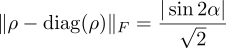
The most striking result across Papers VII and VIII is that the formula sin(2α)∕ appears in both the
boson amplitude and the graviton amplitude, for entirely different physical degrees of freedom. The
explanation is structural: both follow from the off-diagonal norm of a rank-one density matrix formed
from a superposition of two orthogonal unit vectors. For a state ψ = cosαu + isinαv with
u ⊥v,
appears in both the
boson amplitude and the graviton amplitude, for entirely different physical degrees of freedom. The
explanation is structural: both follow from the off-diagonal norm of a rank-one density matrix formed
from a superposition of two orthogonal unit vectors. For a state ψ = cosαu + isinαv with
u ⊥v,
is an algebraic identity, independent of what u and v represent.
This universality suggests that the density matrix decomposition is not a feature of quantum mechanics or
of gravity separately but of the compression principle itself. Whether this observation can be elevated to a
theorem — a proof that any two-regime compression of normalised configurations yields this formula — is
an open question.
The factor 4π appears in three independent calculations in this series: recovering Bekenstein–Hawking
entropy (Paper IV), recovering the Newtonian potential (Paper VIII Theorem 4), and the aspect ratio
between discrete and spherical geometry (Papers IV–V). In each case it is not a free parameter
but the geometric conversion between flat counting and spherical propagation. Its consistent
appearance is encouraging but not yet understood at the level of the cost functional. We
settle to assuming sperical symmetry is the minimal geometric shape satisfying the observer
condition.
The programme is not a completed theory. It is a collection of exact results in discrete toy models, a set of
structural correspondences with known physics, and a conjectured organising equation. The toy models
use 1D chains, conformal metrics, and two-frame sequences. Extensions to four continuous dimensions, the
full tensorial Riemann curvature, and the Fock space of many-fermion systems remain to be carried
out.
The framework does not yet contain a derivation of the Standard Model, does not address the origin of
energy in physical units, and does not derive the masses of elementary particles. These are long-term
targets, not current achievements.
What the framework does suggest — and what the results of Papers VII and VIII make concrete — is
that the separation between quantum mechanics and general relativity may be an artifact of working in
different effective descriptions of the same underlying compression principle. The density matrix
decomposition ρ diag(ρ) + B produces local/non-local structure whether applied to fermion
configurations or metric configurations. The quantum/gravitational duality, in this view, is not a
coincidence to be explained but a consequence to be proved.
diag(ρ) + B produces local/non-local structure whether applied to fermion
configurations or metric configurations. The quantum/gravitational duality, in this view, is not a
coincidence to be explained but a consequence to be proved.
Jacobson [jacobson1995] derived the Einstein equations from thermodynamics of local Rindler horizons.
Verlinde [verlinde2011] derived Newtonian gravity from entropic forces. The present approach derives
geodesics, curvature decomposition, graviton polarisations, and the Newtonian potential from spectral
complexity minimisation alone, without postulating thermodynamics, entropy, or holography as inputs.
Whether entropy and thermodynamics emerge as consequences within the framework is an interesting
open question.
Reconstructions of quantum mechanics from information-theoretic axioms [hardy2001, chiribella2011]
and the Bayesian/QBist programme [fuchs2014] seek to derive the formalism of quantum mechanics
without a physical model of the underlying degrees of freedom. The present approach is complementary: it
proposes a specific physical model (fermions as pixels, bosons as compression residuals) and derives the
quantum formalism from it, but does not yet have a proof that the model forces the full Hilbert space
structure.
I initially tried to set the first principle of the framework as assume nothing, which was itself an
assumption. Any axiomatic system — mathematics included — requires at least one axiom. The minimum
may be just one parameter: the definition of the observer. Everything else could then follow from
that.