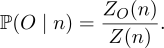
The bit count n appears in equation (5) as CD[n] = log 2n. It would be tempting to conjecture that n is not a free parameter but the saddle point of the observer’s own existence probability.
The probability that observer O exists at all, marginalising over all histories at bit count n, is then:
The prior over n is ℙ(n) ∝ 1∕n (description length of n itself). The joint probability is:
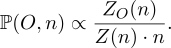
The saddle-point condition — the value of n that maximises the observer’s probability of existence — is formally:
| (6) |
Papers IV and V [meskanen2026iv, meskanen2026v] derive a preferred value n ≈ 184 by two independent routes: matching the inflationary aspect ratio and recovering Bekenstein–Hawking entropy for a solar-mass black hole. If equation (6) independently selects n∗≈ 184, the three routes converge, which would constitute strong evidence for the framework.
That convergence has not yet been verified. The saddle-point equation requires an explicit model of ZO(n) — the partition function of observer-compatible histories as a function of n — for which no tractable expression is currently available.
![∂
--[logZO (n)− logZ (n)− logn ] = 0.
∂n](real-theory-of-everything15x.svg)