The strongest evidence for the programme comes from two recent exact results, which we summarise here.
Both concern the same mathematical object: the off-diagonal density matrix B = ρ − diag(ρ) of a
compressed configuration.
Paper VII [meskanen2026vii] encodes two-frame fermion configurations as complex wavefunctions
ψ = f0 + if1 and computes the density matrix ρ = |ψ⟩⟨ψ|. The off-diagonal part B captures everything
the codec records when a fermion moves between frames.
Four results are established analytically and verified numerically:
- Pauli exclusion. For any stationary single fermion, B = 0 exactly. Double occupancy
produces no compression residual; it is informationally invisible. Pauli exclusion is not a
postulate but the statement that double occupancy has nothing for the codec to encode.
- Universal boson. Every single fermion hop produces ∥B∥ = 1∕
 , independent of chain
length, hop distance, and encoding. The residual carries a universal −π∕2 phase, the defining
signature of a propagator.
, independent of chain
length, hop distance, and encoding. The residual carries a universal −π∕2 phase, the defining
signature of a propagator.
-
Born rule identity. For a fermion in superposition ψ(𝜃) = cos𝜃ei + isin𝜃ej,
where P = sin2𝜃 is the Born-rule hop probability. The boson amplitude is the interference term of
the Born rule, expressed as a matrix norm.
- Virtual propagator lifecycle. ∥B∥ = 0 when the fermion is stationary, rises to 1∕
 at equal
superposition, and returns to 0 when the hop is complete — the lifecycle of a virtual particle,
derived without field theory.
at equal
superposition, and returns to 0 when the hop is complete — the lifecycle of a virtual particle,
derived without field theory.
These results follow from the single definition B = ρ− diag(ρ) and the normalisation of ψ. No interaction
terms, coupling constants, or particle species were introduced.
Paper VIII [meskanen2026viii] applies the identical decomposition to metric configurations: a
two-frame metric pair (g(0),g(1)) is encoded as ψ(x) = g(0)(x) + ig(1)(x). The same ρ diag(ρ) + B split
then yields:
diag(ρ) + B split
then yields:
- Curvature decomposition. ρ decomposes exactly as ρRicci + ρtidal + ρgraviton, with
Tr(ρWeyl) = 0 in every case. The diagonal is identified with local Ricci curvature (the Einstein
source term); the symmetric off-diagonal with tidal (Coulomb Weyl) forces; the antisymmetric
off-diagonal with gravitational waves.
- Two polarisations. The two degenerate graviton polarisation modes emerge as eigenvectors
of ρtidal with eigenvalue −1∕4, protected by the reflection symmetry of the metric profiles. No
spin-2 field is postulated.
-
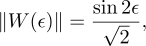
Graviton amplitude theorem. For orthogonal metric profiles at mixing angle 𝜖,
the exact gravitational analogue of equation (2). The formula is independent of metric profiles,
system size, and overall scale.
-
Newtonian potential. Graviton flux conservation over spherical shells gives A(r) ∝ 1∕r exactly,
and the overlap integral yields
The factor 8π = 2 × 4π arises from spherical geometry alone — the same factor that recovers
Bekenstein–Hawking entropy in Paper IV [meskanen2026iv].
- Minimum-complexity orbits. The minimum spectral-complexity closed worldline is ψ(t) = Aeiωt
— a single Fourier mode, tracing an ellipse. Under Solomonoff induction, all other closed trajectories
are exponentially suppressed. Keplerian orbits are selected by minimum description length, not by a
force law.
Equations (2) and (3) are identical in form. This is not a coincidence of presentation. Both follow from
the density matrix decomposition applied to a normalised superposition of two orthogonal
configurations. The formula sin(2α)∕ is the unique consequence of this structure, regardless
of whether α parametrises a fermion in quantum superposition or a metric in gravitational
superposition.
is the unique consequence of this structure, regardless
of whether α parametrises a fermion in quantum superposition or a metric in gravitational
superposition.
The conjecture is that this shared structure reflects a shared origin: quantum field theory and general
relativity are two projections of the same compression principle onto different physical degrees of
freedom.