 paths, with path 0 set to the classical Hawking solution
(
paths, with path 0 set to the classical Hawking solution
( only,
only,  ) and paths
  through
  drawn from the confound-controlled random
ensemble described above.
drawn from the confound-controlled random
ensemble described above.
We evaluated an ensemble of paths, with path 0 set to the classical Hawking solution
( only, ) and paths through drawn from the confound-controlled random
ensemble described above.
| Configuration | Euclidean Action  | Spectral Complexity  |
Classical (no-boundary,  ) ) | 7.2450 | 1.0 |
Min- path path |  7.2 7.2 | 1.0 |
| Typical perturbed (median) |  15–200 15–200 |  10–80 10–80 |
 paths,
  ,
,  ,
,  ). The Hawking instanton (
 only) attains
 , the theoretical minimum.
The Spearman rank correlation between  and
and  across the full ensemble exceeds
  . The
partial Spearman correlation
. The
partial Spearman correlation  remains strongly positive with
  ,
confirming that the correlation is not driven by the common sensitivity to path roughness.
,
confirming that the correlation is not driven by the common sensitivity to path roughness.
The classical Hawking instanton is the unambiguous joint minimum of both  and
and  : it uses only
the
: it uses only
the  mode for the scale factor and zero scalar field, attaining the lowest possible spectral
complexity
mode for the scale factor and zero scalar field, attaining the lowest possible spectral
complexity  . The minimum-
 path recovered from the ensemble has dominant mode
  ,
recovering the Hawking solution.
,
recovering the Hawking solution.
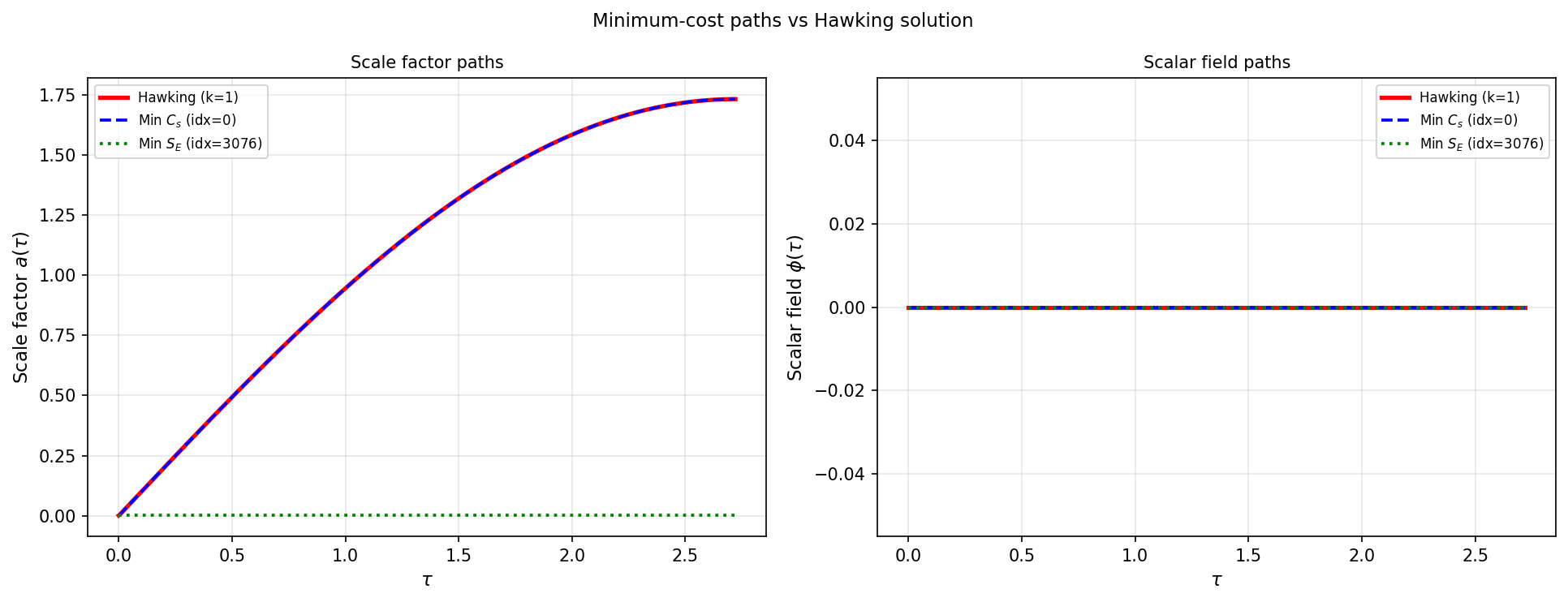
 path (blue dashed), and the minimum-
 path (green dotted).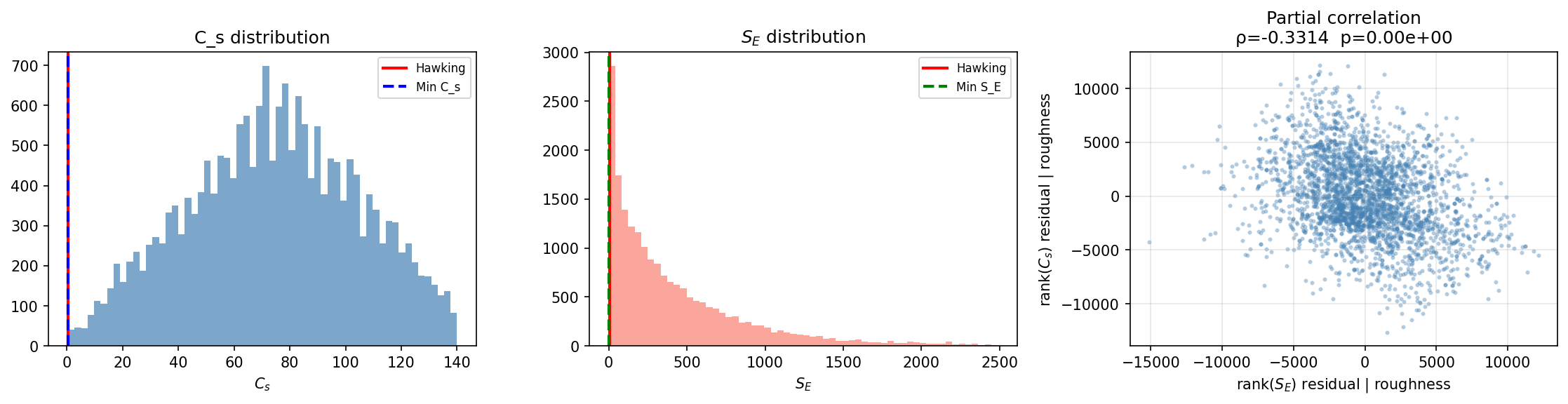
 distribution (left),
  distribution (centre), and the partial correlation residual
scatter after removing the linear effect of roughness (right). The Hawking instanton (red vertical
line) sits at the low end of both distributions.
distribution (centre), and the partial correlation residual
scatter after removing the linear effect of roughness (right). The Hawking instanton (red vertical
line) sits at the low end of both distributions.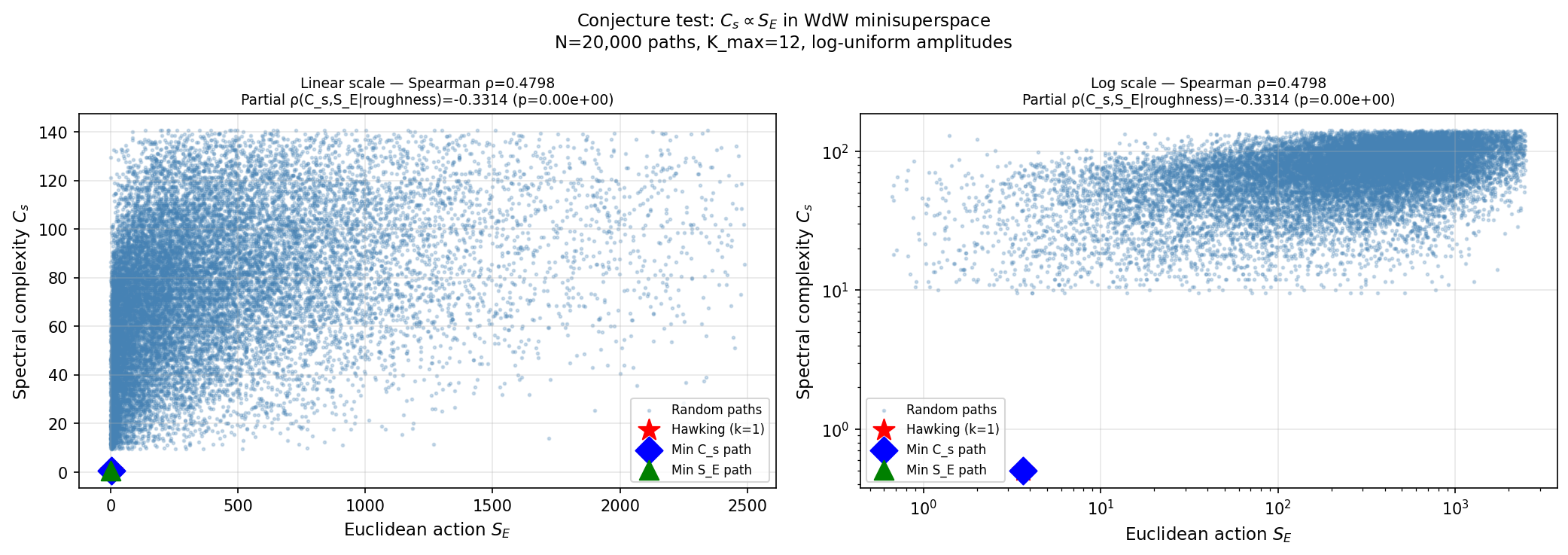
 vs.
vs.  across all 20,000 paths (linear and log scales). The Hawking
instanton (red star) is the joint minimum. Spearman
across all 20,000 paths (linear and log scales). The Hawking
instanton (red star) is the joint minimum. Spearman  and partial
  (controlling for roughness)
are shown in the panel titles.
(controlling for roughness)
are shown in the panel titles.