 and
and  :
:
Paths are parameterised as finite Fourier series in the natural eigenbasis for this boundary value problem
— functions that satisfy and :

with  modes per field. The mode
  reproduces the Hawking solution exactly; higher
modes add higher-frequency corrections. Both
reproduces the Hawking solution exactly; higher
modes add higher-frequency corrections. Both  and
and  use the same basis with independent
coefficients
use the same basis with independent
coefficients  and
and  :
:

The natural frequencies of the basis modes are
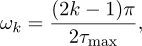
with uniform spacing  . Spectral complexity is computed directly from the Fourier
coefficients, not from a discrete Fourier transform of the discretised path. A DFT of a non-periodic signal
(as every path on
. Spectral complexity is computed directly from the Fourier
coefficients, not from a discrete Fourier transform of the discretised path. A DFT of a non-periodic signal
(as every path on ![[0,τmax]](informational-action29x.svg) is, relative to the DFT’s assumed periodicity) suffers spectral leakage — a
single sine wave fills dozens of DFT bins, artificially inflating
is, relative to the DFT’s assumed periodicity) suffers spectral leakage — a
single sine wave fills dozens of DFT bins, artificially inflating  . Working in the problem’s own basis is
both physically correct and numerically honest.
. Working in the problem’s own basis is
both physically correct and numerically honest.
A mode  is declared active if its power fraction exceeds a threshold
  :
:

Spectral complexity is then the total frequency cost of all active modes across both fields:
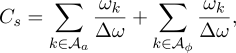
where the ratio  takes values
  by construction. The minimum-
 path is therefore the one that achieves the required boundary conditions using the lowest-frequency modes
— which is precisely
path is therefore the one that achieves the required boundary conditions using the lowest-frequency modes
— which is precisely  , the Hawking solution.
This measure is both smooth and computable in practice. Unlike uncomputable Kolmogorov complexity
[kolmogorov1965] over Turing machines, the dominant cost arises from the sum of frequencies of
retained modes. This makes  a natural, differentiable proxy for algorithmic compressibility in the
physical setting.
a natural, differentiable proxy for algorithmic compressibility in the
physical setting.
Under Solomonoff-like induction the prior becomes  , yielding exponential suppression of
high-frequency (rough) configurations — precisely analogous to the
, yielding exponential suppression of
high-frequency (rough) configurations — precisely analogous to the  weighting in the Euclidean
path integral.
weighting in the Euclidean
path integral.