-bit string: at each
discrete tick one of the
-bit string: at each
discrete tick one of the  bits is chosen uniformly and flipped.
Time is the ordinal index of a random walk through the most compressible configurations. The
minimal—and hence most compressible—path is the path of least change between consecutive
configurations. That path is realised by a fair random bit-flip mutation of an -bit string: at each
discrete tick one of the bits is chosen uniformly and flipped.
This dynamics is the Ehrenfest process. Let  be the number of 1-bits and
  . The expected
change in one tick is
. The expected
change in one tick is
| (1) |
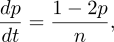
In the continuum limit one obtains the ordinary differential equation
| (2) |
where  is the raw flip count (“bit-flip time”). Starting from the all-zero state
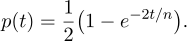
  the solution
is
the solution
is
| (3) |
The relaxation timescale is therefore  ticks. Rescaling to the dimensionless coordinate
  yields the universal curve
| (4) |
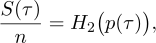
The associated Shannon entropy per bit is
| (5) |
where  .
.
A further change of variable
| (6) |
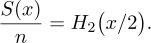
produces a bounded time coordinate whose entropy is simply
| (7) |
This is the universal entropy curve that any physical time scale is ultimately mapped onto.
Compressibility is measured by spectral complexity: the number of bits required to encode the modes (frequencies and phases) of a wavefunction. The Ehrenfest trajectory is the path of least spectral complexity; it is therefore the typical path under the natural measure on configuration space. Solomonoff induction, when formulated with spectral rather than Kolmogorov complexity, preferentially samples exactly this trajectory.
![𝔼 [Δm ] = n-−-m − m- = 1− 2p.
n n](geometry-of-spacetime9x.svg)