Theorem 1 (Universal Boson Norm). For any n-site equal superposition with arbitrary phases,
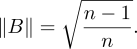
Proof. ρij = (1∕n)ei(ϕi−ϕj), so |Bij|2 = 1∕n2 for all i≠j. There are n(n − 1) off-diagonal pairs, giving ∥B∥2 = n(n − 1)∕n2 = (n − 1)∕n. □ □
Proof. Fk = |ψk|2 = 1∕n for all k, so ∥F∥2 = ∑ k1∕n2 = 1∕n. □ □
Proof. For any pure state, ρ2 = ρ, so ∥ρ∥2 = Tr(ρ2) = Tr(ρ) = 1. Since F and B occupy orthogonal subspaces, ∥ρ∥2 = ∥F∥2 + ∥B∥2 = 1. □ □
Remark (Connection to Paper VII). For ψ(𝜃) = cos𝜃ei + isin𝜃ej, ∥B(𝜃)∥2 = sin2(2𝜃)∕2 (Paper VII, exact). Then ∥F(𝜃)∥2 = cos4𝜃 + sin4𝜃, and

Theorem 3 subsumes the Paper VII result as a special case.
Corollary 1 (Pauli exclusion). For a localised fermion ψ = ej: ∥F∥ = 1, ∥B∥ = 0. No compression residual is produced. Double occupancy has zero off-diagonal content and is informationally invisible.
Table 1 summarises the theorems for small n.
| n | ∥F∥ = 1∕ | ∥B∥ = 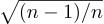 | ∥F∥2 | ∥B∥2 |
| 1 | 1 | 0 | 1 | 0 |
| 2 | 1∕ | 1∕ | 1∕2 | 1∕2 |
| 3 | 1∕ |  | 1∕3 | 2∕3 |
| 4 | 1∕2 |  ∕2 ∕2 | 1∕4 | 3∕4 |

