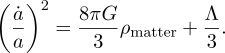
The Friedmann equation governs the expansion of a homogeneous, isotropic universe in General Relativity:
The present framework maps onto this equation under the identifications:
| (3) |
These identifications are not free parameters. They follow from the counting argument: matter entity density maps to ρmatter because matter entities brake expansion by consuming fabric; free fabric density maps to Λ because it drives expansion by providing addressable resolution. The cosmological constant is not a parameter of the vacuum energy — it is the fraction of the bit budget that remains unbound.
The two GR boundary solutions are recovered exactly:
| Limit | Information picture | GR solution |
| k = 0, m = 0 | All bits free, R = 1 | De Sitter (Λ > 0, ρ = 0) |
| k = 1, m = n | One entity, R = 1∕n | Schwarzschild singularity |
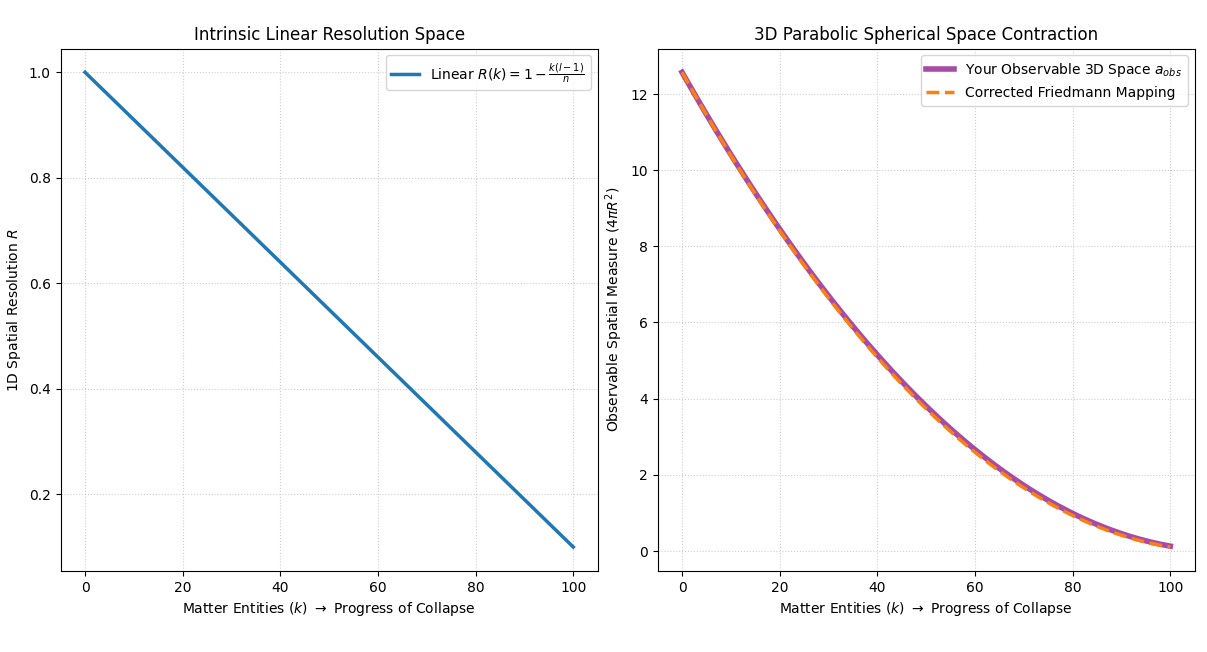
Numerical analysis shows the spatial contraction profile matches also across all states.