Experiments 1–6 establish four results, each analytically exact:
- Pauli exclusion. B = 0 for any stationary fermion, for any encoding of the form ψ ∝ej.
Double occupancy is informationally invisible: zero compression residual, zero boson.
Proof: ρik = |α|2δijδkj = 0 for i≠k. □
- Universal boson. Every single fermion hop produces ∥B∥ = 1∕
 , independent of chain
length, hop distance, and encoding. The boson carries a universal −π∕2 phase.
, independent of chain
length, hop distance, and encoding. The boson carries a universal −π∕2 phase.
- Born rule identity. ∥B(𝜃)∥ =
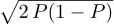 , where P = sin2𝜃 is the Born-rule hop
probability. The boson amplitude is the interference term of Born rule.
, where P = sin2𝜃 is the Born-rule hop
probability. The boson amplitude is the interference term of Born rule.
- Virtual propagator. The boson amplitude follows sin(2𝜃)∕
 over the fermion’s journey:
born at 𝜃 = 0, maximum at 𝜃 = π∕4, vanished at 𝜃 = π∕2. This is the propagator of a virtual
particle, derived without field theory.
over the fermion’s journey:
born at 𝜃 = 0, maximum at 𝜃 = π∕4, vanished at 𝜃 = π∕2. This is the propagator of a virtual
particle, derived without field theory.
All four results follow from the single definition B = ρ − diag(ρ) applied to the compressed
wavefunction. No interaction terms, coupling constants, or postulated particle species were
introduced.
Experiment 7 adds a fifth, exploratory result, reported at a different evidentiary tier:
- Mass–momentum–boson identity (numerically verified, not yet derived from Cs).
Under the two-band extension of §8, ∥B(k)∥ = |tsink|∕(
 E(k)), which reduces to the
universal 1∕
E(k)), which reduces to the
universal 1∕ of Result 2 at m = 0 and reproduces E2 = (pc)2 + (m0c2)2 in the continuum
limit.
of Result 2 at m = 0 and reproduces E2 = (pc)2 + (m0c2)2 in the continuum
limit.