 formula analytically and confirm it holds across all chain lengths and site
separations.
formula analytically and confirm it holds across all chain lengths and site
separations.
Python: theta_scaling.py
We verify the sin(2𝜃)∕ formula analytically and confirm it holds across all chain lengths and site
separations.
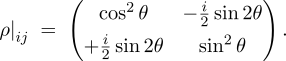
For ψ(𝜃) = cos𝜃ei + isin𝜃ej (normalised, i≠j), the density matrix ρ = |ψ⟩⟨ψ| has the block structure (showing only the i,j subspace, all other entries zero):
Removing the diagonal gives the boson matrix restricted to the same subspace:
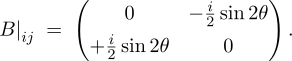
In full, the components are:
| ρii | = cos2𝜃, ρ jj = sin2𝜃, | ||
| ρij | = ψiψj∗ = cos𝜃 ⋅ (−isin𝜃) = − sin2𝜃, sin2𝜃, | ||
| ρji | = + sin2𝜃. sin2𝜃. |
All other entries of ρ are zero since ψk = 0 for k≠i,j. Therefore:

giving
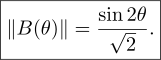
This proof uses only the definition B = ρ − diag(ρ) and the normalisation of ψ. It is independent of L, the separation |i −j|, and any overall phase factor on ej. Numerical verification confirms agreement to within floating-point precision (< 4 × 10⁻¹⁶) for L ∈{4,8,16,32,64,128} and all hop distances.
Let P = sin2𝜃 be the Born-rule probability that the fermion occupies site j. Then:

∥B∥ is  times the geometric mean of the hop and no-hop probabilities. This is the interference term of
the Born rule, made visible as a matrix norm. The boson amplitude is not an approximation or an
emergent average: it is the exact quantum interference encoded in the density matrix.
times the geometric mean of the hop and no-hop probabilities. This is the interference term of
the Born rule, made visible as a matrix norm. The boson amplitude is not an approximation or an
emergent average: it is the exact quantum interference encoded in the density matrix.
The formula ∥B(𝜃)∥ = sin(2𝜃)∕ traces the complete lifecycle:
 . Boson at maximum amplitude.
The boson is born when the fermion begins to move, peaks at mid-hop, and vanishes when the fermion arrives. This is the lifecycle of a virtual particle — a propagator in the language of quantum field theory, derived here without postulating field theory.