Python: scaling_1.py, scaling_2.py
We scale to longer chains (L = 4,6,8,12,16) and more frames, testing whether momentum quantisation k = 2πm∕L holds and whether the boson properties depend on system size.
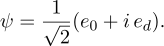
For any single fermion hop from site 0 to site d, regardless of L or d:
The boson matrix has exactly two non-zero entries:

For the nearest-neighbour hop (d = 1, L = 4) this reads explicitly:
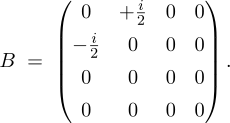
The same 2×2 antisymmetric block 
| 0 | +i∕2 |
| −i∕2 | 0 |
 is embedded at positions (0,d) and (d,0) for any hop distance d and any chain length L; all other entries
are zero. The matrix is always purely antisymmetric, always has eigenvalues ±1∕2, and the phase of B0,d
is always −π∕2, giving:
is embedded at positions (0,d) and (d,0) for any hop distance d and any chain length L; all other entries
are zero. The matrix is always purely antisymmetric, always has eigenvalues ±1∕2, and the phase of B0,d
is always −π∕2, giving:

This is not a plane-wave momentum but a phase relationship between the two fermion sites: the boson encodes exactly one number, the π∕2 phase shift between where the fermion was and where it went. A quarter-turn in phase space is the defining property of a propagator. This is what a virtual photon does in QED.
Conclusion: The compression residual of a single fermion hop is an antisymmetric, purely imaginary, ±1∕2-eigenvalued object carrying a universal π∕2 phase, independent of chain length and hop distance.