2026-05-19
We extend a minimal information-theoretic model of structure formation from discrete bitstring dynamics to continuous complex-valued wavefunctions defined over spacetime. In the original formulation, increasing entropy in a finite binary sequence led to the emergence of hierarchical structures under simple pattern-detection rules.
Here, we generalize this idea by defining a variational problem over a spacetime wavefunction \(\Psi(x,y,t)\), constrained to follow a prescribed entropy trajectory while minimizing spectral complexity. The resulting optimized configurations exhibit persistent, spatially localized structures even in high-entropy regimes.
This demonstrates that structure can arise not from low entropy alone, but from global constraints on representation complexity. The results suggest that increasing entropy expands the space of accessible configurations, within which structured subregions emerge as stable features under minimal-description principles.
In earlier work, we introduced a minimal computational model in which a finite bitstring evolves from a zero-entropy state through random mutations. As entropy increases, simple pattern-detection rules applied to the bitstring reveal the emergence of hierarchical structures. This demonstrated that increasing entropy does not preclude structure, but rather enables the formation of statistically stable patterns within a growing configuration space.
However, the bitstring model is inherently discrete and representation-dependent. A natural question is whether this phenomenon persists in more general settings, particularly in continuous or wave-like representations more closely aligned with physical theories.
In this work, we extend the model to complex-valued wavefunctions defined over a discrete spacetime lattice. Instead of simulating stochastic evolution, we construct spacetime configurations via global variational optimization. The system is constrained to follow a prescribed entropy trajectory while minimizing a spectral complexity functional.
This formulation removes explicit particle definitions and replaces them with a general principle: structures correspond to regions that remain stable under global constraints on representation complexity. We investigate whether such structures arise naturally even in high-entropy regimes.
We consider a complex-valued wavefunction: \[\Psi : \mathbb{Z}_W \times \mathbb{Z}_H \times \{0, \dots, T-1\} \to \mathbb{C}\]
For each time slice \(t\), we define its Fourier transform: \[\Psi_k(t) = \mathcal{F}[\Psi(x,y,t)]\]
We define spectral complexity as: \[C(t) = \sum_k k^2 |\Psi_k(t)|^2\]
where \(k^2 = k_x^2 + k_y^2\) denotes squared frequency magnitude.
To obtain a stable and controllable entropy profile, we define the spatial probability distribution using a temperature-scaled transformation of the amplitude:
\[p(x,y,t) = \frac{\exp\left(\beta(t) \log(|\Psi(x,y,t)|^2 + \epsilon)\right)}{\sum_{x,y} \exp\left(\beta(t) \log(|\Psi(x,y,t)|^2 + \epsilon)\right)}\]
where \(\beta(t) > 0\) is a time-dependent inverse temperature parameter, and \(\epsilon\) ensures numerical stability.
The Shannon entropy is then: \[H(t) = -\sum_{x,y} p(x,y,t)\log p(x,y,t)\]
This formulation allows direct control over the entropy of each time slice by modulating \(\beta(t)\).
We impose a smooth entropy trajectory of the form: \[H_{\text{target}}(t) = H_{\text{start}} + (H_{\text{end}} - H_{\text{start}})\left(1 - e^{-\kappa \frac{t}{T-1}}\right)\]
where: \[H_{\text{start}} = \alpha_{\text{start}} \log(W \cdot H), \quad H_{\text{end}} = \alpha_{\text{end}} \log(W \cdot H)\]
and \(\kappa > 0\) controls the rate of approach to the asymptotic entropy.
This formulation allows the system to evolve from intermediate entropy states toward near-maximal entropy.
We parametrize \(\Psi_k(t)\) directly as a learnable tensor in Fourier space and optimize:
Real and imaginary components as independent variables
Gradient descent via Adam optimizer
At each iteration:
Construct \(\Psi_k(t)\)
Compute inverse FFT to obtain \(\Psi(x,y,t)\)
Evaluate entropy and complexity
Backpropagate total loss
The optimization is performed globally over all time slices simultaneously.
The optimized spacetime wavefunction exhibits the following properties:
For large \(t\), entropy approaches its maximum: \[H(t) \approx \log(W \cdot H)\]
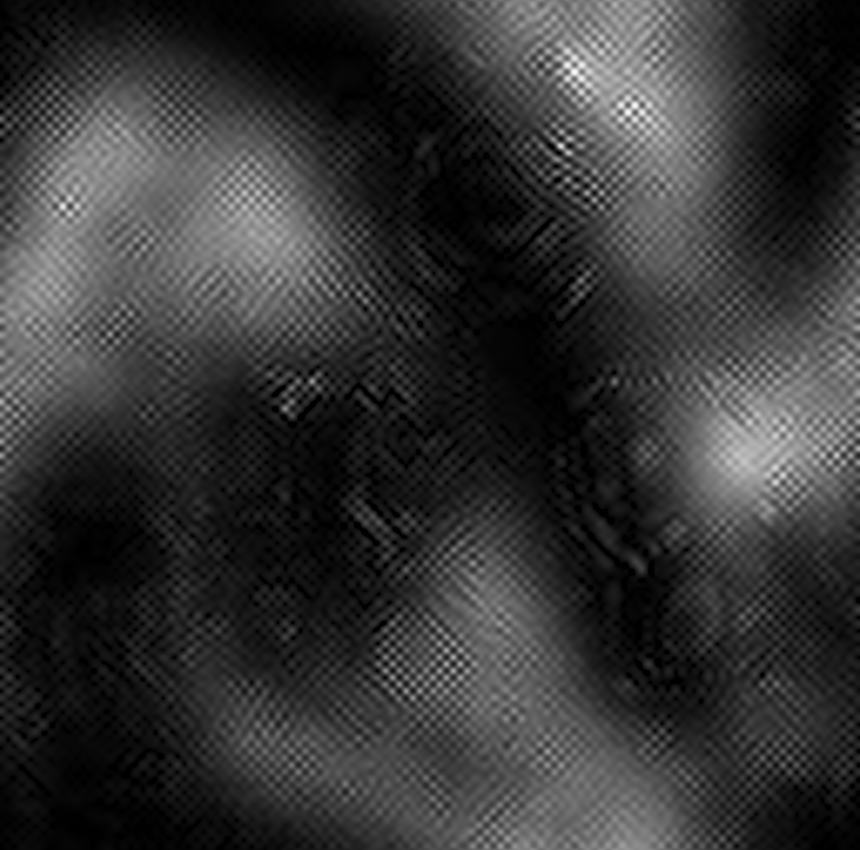
The spatial distribution resembles noise, but is not fully random.
Despite near-maximal entropy, the probability field contains:
spatially localized peaks
coherent interference patterns
These structures arise from constructive interference of Fourier modes.
Structures persist across adjacent time slices. This occurs because:
large spectral changes increase \(C(t)\)
maintaining continuity minimizes total functional cost
Thus, the optimizer favors gradual deformation over discontinuous reconfiguration.
For large \(t\), entropy approaches its prescribed upper bound: \[H(t) \approx H_{\text{end}}\]
Despite this, the spatial distribution is not fully uniform. Instead, it exhibits structured deviations from randomness.
The probability field contains spatially localized peaks and coherent interference patterns. These structures are not imposed explicitly, but arise from the constraint that the wavefunction must simultaneously:
maintain high entropy, and
minimize spectral complexity.
This tension leads to configurations in which localized regions concentrate probability mass while the global distribution remains broadly dispersed.
Structures persist across adjacent time slices due to the global nature of the optimization. Large temporal variations would increase spectral complexity, so the optimizer favors configurations that evolve smoothly over time.
This produces coherent trajectories of localized structures, resembling persistent objects in spacetime.
The results demonstrate that high entropy does not eliminate structure. Instead, increasing entropy expands the space of accessible configurations, within which structured subregions can emerge as stable solutions under global constraints.
In the earlier bitstring model, structure appeared as recurring patterns within an expanding combinatorial space. In the present formulation, structure appears as localized concentrations of probability within a high-entropy field.
In both cases, the underlying mechanism is the same: entropy increase enlarges the configuration space, while constraints on representation (such as spectral minimality) select structured configurations within that space.
This suggests that structure is not in opposition to entropy, but rather a consequence of constrained optimization within high-entropy ensembles.locality constraints, interaction potentials nor predefined object models.
Potential extensions include definition of observer functionals over \(\Psi(x,y,t)\)
We have extended a discrete, entropy-driven model of structure formation to a continuous wavefunction-based framework. By imposing a prescribed entropy trajectory and minimizing spectral complexity, we construct spacetime configurations that exhibit persistent, localized structures even near maximal entropy.
These results support the view that structure emerges not from low entropy alone, but from the interplay between entropy and global constraints on representation. Increasing entropy expands the space of possible configurations, while minimal-complexity principles select structured solutions within that space.
This provides a unified perspective in which spacetime structure and matter-like features arise naturally from information-theoretic principles, without requiring explicit physical interaction laws.