Abstract
Paper VI [meskanen2026v] presented the hypothesis that the quantum mechanical
wavefunction is the compression signature of nature: the universe is a finite, static bitstring
of n bits, and the path an internal observer experiences is the one that compresses best
under a complex-valued spectral codec. The present paper supports this hypothesis with seven
experiments implemented in Python and included as supplementary material. We show that a
photon-like boson emerges as the compression residual of a purely fermionic system, without any
interaction term introduced by hand. All essential features of quantum mechanics are recovered:
Born rule, Pauli exclusion, particle–antiparticle pairing, and the virtual propagator. The central
result is an analytically exact theorem: for a single fermion in superposition between two sites,
the off-diagonal (boson) amplitude is ∥B(𝜃)∥ = sin(2𝜃)∕ , independent of system size, site
separation, and encoding. This equals
, independent of system size, site
separation, and encoding. This equals 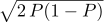 , the interference term of the Born rule, made
visible as a matrix norm. We further report an exploratory extension in which the same B-matrix
formalism is applied, unchanged, to a two-band lattice Hamiltonian H(k) = mσz + tsin(k)σx,
giving a boson-residual amplitude ∥B(k)∥ = |tsink|∕(
, the interference term of the Born rule, made
visible as a matrix norm. We further report an exploratory extension in which the same B-matrix
formalism is applied, unchanged, to a two-band lattice Hamiltonian H(k) = mσz + tsin(k)σx,
giving a boson-residual amplitude ∥B(k)∥ = |tsink|∕( E(k)) with E(k) =
  ,
which recovers the relativistic dispersion relation E2 = (pc)2 + (m0c2)2 as its continuum limit.
This result is numerically verified but not yet derived from the spectral complexity functional Cs,
and is reported as a genuinely open problem rather than a closed theorem. These results suggest
that quantum mechanics is not a foundational layer of reality but an emergent description —
the story an observer tells about fermions sampled from a compression codec.
,
which recovers the relativistic dispersion relation E2 = (pc)2 + (m0c2)2 as its continuum limit.
This result is numerically verified but not yet derived from the spectral complexity functional Cs,
and is reported as a genuinely open problem rather than a closed theorem. These results suggest
that quantum mechanics is not a foundational layer of reality but an emergent description —
the story an observer tells about fermions sampled from a compression codec.